
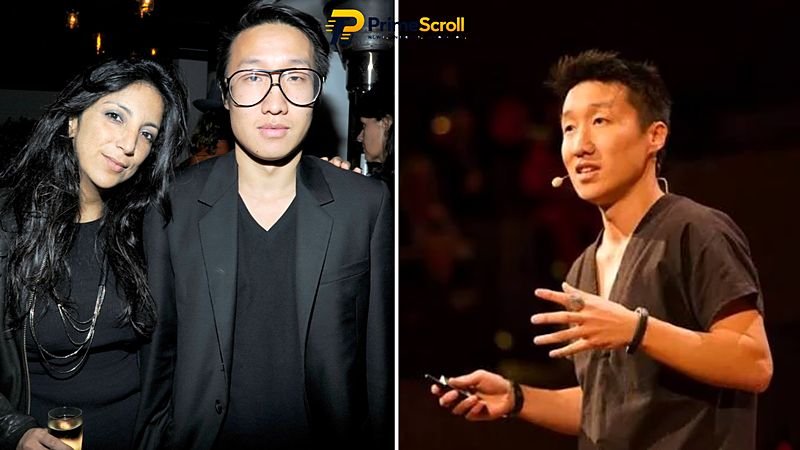
Type his name into Google and you’ll find a pile of near-identical biographies. Most are padded with vague praise, and several can’t agree on where he was born or which university he attended.
The documented story is far more interesting than the filler. It involves a stage tour with two of the biggest names in hip-hop, a Kickstarter campaign built around dreams, a Harvard psychologist as an adviser, and several years inside Dubai’s government-backed innovation machine.
This is the version built from interviews and news coverage rather than recycled bio pages.
Who Is Hunter Lee Soik?
Hunter Lee Soik is an entrepreneur, experience designer and futurist. He started out in creative direction, moved into consumer tech, and later into innovation and policy work.
In his own telling, he was adopted from Korea as a baby and grew up in a small town in Wisconsin. He has said he never finished college. He has described the mystery around his origins as the source of a long-running curiosity about people and the world.
That curiosity is the thread that ties his unrelated-looking jobs together.
The Creative Years: Watch the Throne and Beyond
Before he was a founder, Soik worked as a creative consultant and experience designer. Coverage from the early 2010s links him to the Watch the Throne tour by Jay-Z and Kanye West in 2012.
He is also described as having done experience design for brands and institutions such as Stella McCartney, Vitra, the CFDA Awards and Art Basel. Fast Company, in its profile of him, called him a freelance creative director whose clients included Kanye West and Italian Vogue.
This matters because it explains his later thinking. His job was to imagine how people would feel inside an experience and then make it real. He later said the idea for SHADOW grew out of that kind of work, a side effect of designing brand experiences.
SHADOW: The Idea Behind the App
After the tour, Soik took time to rest and started paying attention to his own sleep. He has said he taught himself to lucid dream. One dream in particular inspired the idea, and he used it as the sample entry in an early version of the app.
What SHADOW Was Supposed to Do
SHADOW began as a smart alarm clock. Instead of yanking you out of sleep, it used a series of escalating alarm sounds meant to blend into your sleep cycle. Once you woke, the app prompted you to record your dream, either by speaking or typing.
The bigger plan was the real hook. Every recorded dream would feed a global, searchable database. Users could keep entries private or share them with groups.
Cool Hunting reported that the team pointed to research suggesting most dreams are forgotten shortly after waking. The pitch was simple: capture them before they vanish.
Why the Name?
The name comes from Carl Jung. In Jungian thinking, your “shadow” is the part of the unconscious that holds assumptions and desires you don’t know you have. Soik described the app as a way to examine that hidden side and see how it connects to other people around the world.
The Team and the Advisers
Soik co-founded SHADOW with technology entrepreneur Jason Carvalho. Raf Stuken joined as creative director. The team was spread across the world: Soik in New York, Carvalho in Vancouver, and design and engineering in Berlin.
What gave the project credibility was its advisory circle. It included dream researchers such as Kelly Bulkeley, Scott Sparrow and Ryan Hurd, along with Deirdre Barrett, a clinical psychologist at Harvard Medical School.
Barrett told Fast Company that earlier online collections of dream reports, such as those after 9/11, were smaller and less systematic than what SHADOW could gather. Researchers also stressed that dreams don’t come with a universal “dream dictionary.” That is an honest caution, and it shaped how the app talked about its own data.
The Kickstarter
The campaign launched on 17 September 2013. ABC News reported a goal of $50,000, with backers able to vote with their money for the first platform: iOS, Android or Windows. I could not find a reliable source confirming the final funding total, so I won’t state one.
The Dubai Chapter
By early 2016, Soik’s attention had shifted. According to his professional profile, he joined the founding team of the Dubai Future Foundation in March 2016.
His listed roles include:
- Head of Global Community at the Dubai Future Foundation (2016–2017)
- Head of Program for Dubai Future Talks (2017)
- Project team member on the Museum of the Future, the Dubai Future Academy and the Office of the Future
- Head of Innovation and Futures at the Dubai Airport Freezone Authority, or DAFZA (December 2017 to December 2019)
- Steering committee member for Dubai CommerCity, a joint venture between DAFZA and Wasl, reported at AED 3.2 billion
- Speaker at the Seamless conference and jury member at the UAE Innovation Awards in 2018
Other bios also say he was involved with the Dubai Future Accelerators, a nine-week program in which technology companies work with government bodies on real city challenges. Check specific titles against his current profiles before quoting them, since these roles come from self-reported career listings.
His Career at a Glance
| Period | Focus | Notable Detail |
|---|---|---|
| Early 2010s | Creative consulting | Watch the Throne tour, brand and art-world projects |
| 2013 onward | Consumer tech | SHADOW dream app and Kickstarter launch |
| 2016–2017 | Government innovation | Dubai Future Foundation founding team |
| 2017–2019 | Free-zone innovation | DAFZA Head of Innovation and Futures |
| Later | Venture building | Reported chairman of the enso group |
The “Inventing Anna” Connection
Many people first hear his name because of the Netflix series Inventing Anna. Media reports have said the character Chase Sikorski was inspired by Soik, and that he had a personal connection to Anna Sorokin, the fraudster at the center of the story.
It’s a real part of why his name trends, but it is a side note to his own career. Treat details about the relationship carefully, and rely on major news outlets rather than gossip pages.
What We Can Learn From His Path
A few patterns stand out when you look at the whole timeline.
- He starts with a personal itch. SHADOW began with his own curiosity about dreams, not a market report.
- He borrows credibility. He recruited dream researchers early, which made a risky idea feel serious.
- He moves between fields. Entertainment, apps and government look unrelated, but each rewards someone who can imagine the future and sell it.
- He is honest about uncertainty. His own advisers were careful about what dream data could and could not prove.
Frequently Asked Questions
Who is Hunter Lee Soik?
He is an entrepreneur and experience designer, best known as co-founder of the SHADOW dream app and for later innovation roles connected with Dubai’s government-backed programs.
What was the SHADOW app?
It was a smart alarm and dream journal. It woke users gently, asked them to record their dreams by voice or text, and aimed to build a global dream database.
Who worked on SHADOW with him?
Jason Carvalho was co-founder and Raf Stuken was creative director. Dream researchers including Deirdre Barrett, Kelly Bulkeley, Scott Sparrow and Ryan Hurd served as advisers.
What did he do in Dubai?
His profile lists roles at the Dubai Future Foundation from 2016 and at DAFZA as Head of Innovation and Futures from late 2017 to late 2019.
Is the character in Inventing Anna based on him?
Media reports say the character Chase Sikorski was inspired by him. That detail is secondary to his professional record.
What is his net worth?
There is no reliable, verified figure. Numbers on bio sites usually come with no source, so it’s safer not to repeat them.
Final Thoughts
Hunter Lee Soik’s story is a good example of a career built on curiosity rather than a fixed plan. He went from stage design to a dream-tracking startup, then into the planning rooms of a government that markets itself as a laboratory for the future.
Whether SHADOW became the world’s largest dream database is a different question from whether the idea was worth trying. The honest answer is that it pushed people to treat dreams as something worth recording and studying. If you write or read about him, stick to interviews and reputable reporting, because the recycled bios are where most of the errors live.
Sources consulted: Fast Company, Forbes, ABC News, Cool Hunting, Core77, Reality Sandwich, Daily Grail, and his publicly listed professional profile.
Also Read: Martin O’Neill: The Law Student Who Became Football’s Greatest Survivor



One thought on “Hunter Lee Soik: The Designer Who Tried to Build the World’s Biggest Dream Database”